

If you’ve ever wondered what would happen if a group of unsuspecting tourists wandered onto a Greek island only to be greeted by a cannibal with a taste for the theatrical and, apparently, for his own intestines, then Antropophagus is the cinematic delicacy you never knew you needed. Joe D’Amato's notorious gut muncher, infamous on the UK’s Video Nasties list, is the kind of film that makes you question not just the boundaries of taste, but perhaps your own sanity for watching it in the first place.
The plot is a classic in the “let’s go somewhere and all definitely die” school of horror. A group of travellers, led by Tisa Farrow (Mia’s less famous, but now arguably more traumatised, sister), detour to a sun-drenched Greek island at the behest of a mysterious hitchhiker. The locals are missing, the tarot cards are screaming bad idea, and the only welcoming committee is a blind girl hiding in a wine barrel and a rotting corpse that looks like it lost a fight with a cheese grater. Naturally, our heroes decide to stick around, which is the horror movie equivalent of poking a bear with a stick made of bacon.
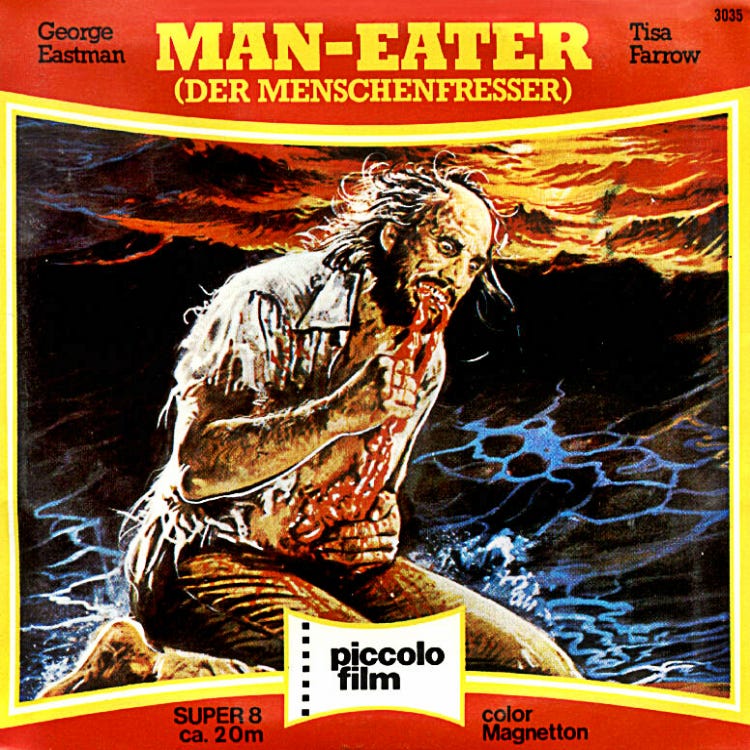
Enter Nikos, the titular “antropophagus,” played with wild-eyed gusto by Luigi Montefiori (aka George Eastman), who manages to be both menacing and, in a certain light, oddly dashing if you're into the “deranged, cannibalistic shipwreck survivor with a penchant for DIY surgery” look. Nikos stalks the cast with all the subtlety of a sledgehammer, dispatching them with increasing inventivity. The film’s most infamous moments, ripping a foetus from a pregnant woman and chowing down, then later gnawing on his own intestines after being mortally wounded, are less shocking for their realism (the foetus is clearly a skinned rabbit) than for their sheer audacity. It’s as if D’Amato dared censors to look away, then doubled down to ensure they did.
The gore, while plentiful, is often so unconvincing that it crosses into the realm of performance art. Watching Nikos eat his own guts is less “body horror” and more “man at a butcher’s shop with no table manners.” Yet, there’s a certain charm to the practical effects, a reminder of a time when horror directors had to make do with rabbit carcasses, red paint, and a prayer. Something that is keenly lacking in today’s CGI farces. The setting, a sun-bleached, abandoned island, is genuinely atmospheric and proof that even the most tasteless acts of cinematic cannibalism benefit from good location scouting.
However, what truly sets Antropophagus apart is its ability to oscillate between genuine dread and unintentional comedy. The pacing is glacial, the acting ranges from “earnestly terrified” to “waiting for lunch break,” and the dialogue is primarily a vehicle for getting people into rooms where they can be eaten. Yet, for all its narrative clumsiness, the film conjures a sense of doom and isolation that's hard to shake. It’s like watching a Greek tragedy, if the tragedy involved more face biting and fewer cathartic revelations.
Ultimately, Antropophagus is less a film than an endurance test, a badge of honour for horror fans who want to say they’ve seen “the one where the guy eats his own intestines.” It’s crude, grotesque, and occasionally so inept it circles back to brilliance. You should look elsewhere if you’re looking for a horror film to haunt your dreams. But if you want to impress your friends at parties by describing the most tasteless thing you’ve ever seen, Antropophagus is a feast you won’t soon forget, no matter how hard you try.


